Indian International Conference
on Air Quality Management
Dr. Vikram Choudhary
IIT Madras
About the Speaker
Dr. Vikram Choudhary
Dr. Vikram Choudhary is an Assistant Professor of Environmental Engineering in the Department of Civil Engineering at IIT Madras. He did his B.Tech. in Civil Engineering from 2010 to 2014 at NIT Jalandhar. Later, he obtained his Master’s and Ph.D. degrees in Environmental Engineering in 2018 and 2023, respectively. His Master’s and doctoral research focused on the evolution of the physicochemical characteristics of organic aerosols and their impact on Earth’s radiative balance. After completing his Ph.D., Dr. Choudhary joined the Air Pollution Exposure Laboratory (APEL) in the Department of Medicine at the University of British Columbia in Vancouver, Canada, as a postdoctoral scholar. His postdoctoral research involved the characterization and integration of an oxidative flow reactor to produce real-world aerosol compositions for controlled human air pollution exposure studies at APEL. Additionally, he investigated the effects of the chemical composition of air pollutants on cellular responses and biological pathways in vitro. His research interests include understanding the atmospheric and cryospheric chemistry of aerosols in controlled (laboratory) environments, toxicology, and air pollution control devices.
Effect of chemical changes during photochemical aging of biomass burning aerosols on toxicity
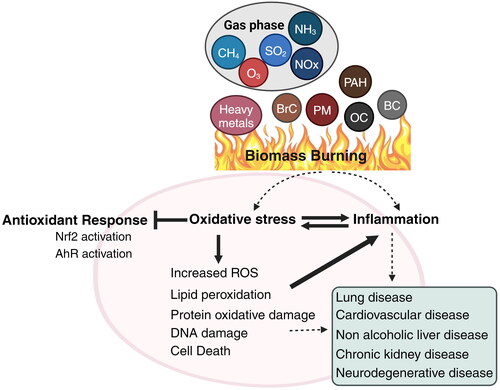
Biomass burning emissions are a major contributor to ambient air pollution globally. After emissions, these air pollutants are subjected to several atmospheric chemical processes, such as photochemical oxidation and nitrate radical (night-time) aging. These processes can lead to the formation of new particles and alter the physicochemical characteristics of existing particles (secondary aerosols/changes). However, our understanding of how these processes affect in vitro cellular toxicity remains limited. Additionally, there have been no controlled human studies focused on air pollution exposures involving aged (secondary) air pollutants; most studies have used freshly emitted pollutants, which do not accurately reflect real-world air pollution composition. In this study, we exposed human lung epithelial cells (A549) to both freshly emitted and photochemically aged biomass burning air pollutants. We examined their effects on cytotoxicity, oxidative stress, and inflammation pathways. Our findings revealed that photochemical aging increases aerosol toxicity, leading to higher levels of oxidative stress and inflammation. Furthermore, we found that the toxicity was associated with chemical changes that occurred during aging, particularly in the O:C ratio.