Indian International Conference
on Air Quality Management
Dr. Suresh Pandian Elumalai
Indian Institute of Technology (ISM) Dhanbad
About the Speaker
Dr. Suresh Pandian Elumalai
Suresh Pandian Elumalai holds B.Tech degree in Chemical engineering from Arunai Engineering College, University of Madras, Chennai, Tamil Nadu in 2002, M. Tech. degree in Environmental Engineering from Pondicherry University, Puducherry, India in 2005 and Ph.D. from Indian Institute of Technology, Guwahati, India in 2011.
Since then he is serving as a faculty member (Associate Professor) in Environmental Science and Engineering at the Department of Environmental Science and Engineering, Indian Institute of Technology (Indian School of Mines, Dhanbad, Jharkhand, India to till date.
His major area of research are vehicular emission and dispersion modeling, rain water analysis for air pollutants reaction, PM exposure dose, urban heat island effects and emission inventory.
ASSESSMENT OF SUSTAINABLE SCHOOL TRANSPORT POLICIES ON VEHICULAR EMISSIONS
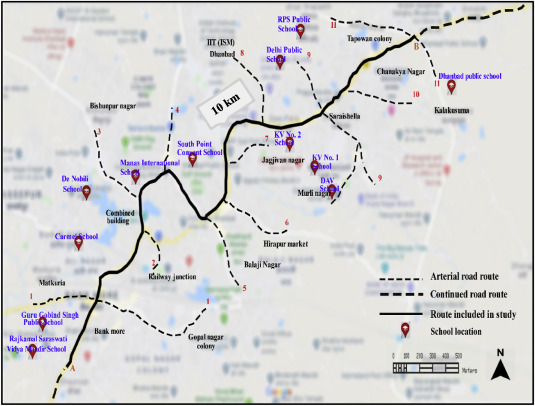
The increased vehicle demand leads to a rise in congestion, exhaust emissions and travel duration. It makes countries adopt policies to reduce vehicular exhaust emissions to achieve sustainable development with improved air quality. The present study identifies factors that influence student’s preferences, estimate vehicular emissions and examine policies to minimize use of passive school transport (PST). The responses of 945 students are statistically examined using the Multinominal Logit (MNL) model with factors that affect preferences of school transport. The MNL model revealed that private transports are preferred more by female students. Students covering up to 3 km distance preferred more to use active school transport (AST) than students with travel distance of above 5 km. The model has predicted that students with travel distance of 4 km or above are mostly opted for public travel modes. The representative driving cycle was developed for morning and afternoon school trips and used as an input parameter for the International Vehicle Emission (IVE) model to estimate exhaust emissions. School policies are proposed to reduce PST modes associated student kilometer travelled (SKT) and emissions. The study outcomes revealed that neighborhood school policy predicted significant reduction in yearly SKT for AST (6.07%) and PST (36.03%) modes. While increased walkability policy anticipates modest impact in minimizing the PST mode associated total exhaust emissions (3.18–40.34%). The private vehicle associated SKT and total exhaust emissions are reduced by nearly 27.58% and 34.66% under increased use of public transport policy respectively.