Indian International Conference
on Air Quality Management
Dr. Lekshmi Mohan V
National Institute of Technology
About the Speaker
Dr. Lekshmi Mohan V
Dr. Lekshmi Mohan V currently serves as an Assistant Professor in the Department of Civil Engineering at National Institute of Technology (NIT), Tiruchirappalli. With a decade of invaluable experience in the field of Air Quality Management and holding a Ph.D. in Civil Engineering from IIT Madras, she brings a wealth of expertise to her academic pursuits. Her academic journey includes an M.Tech. degree in Environmental Engineering from SV National Institute of Technology, Surat. Prior to her academic career, Dr. Lekshmi contributed significantly to real-world Air Quality Management challenges during her tenure as a Senior Program Associate-Air Quality at the World Resources Institute (WRI) India. There, she focused on policy implementation and management aspects for air pollution in collaboration with the Greater Chennai Corporation. Dr. Lekshmi’s commitment to advancing knowledge in her field is evidenced by her impressive track record, which includes over 10 research and conference publications and a patent for a portable air purifier. Her research interests span indoor and urban air quality monitoring, modelling, air pollution control technologies, and exposure assessment.
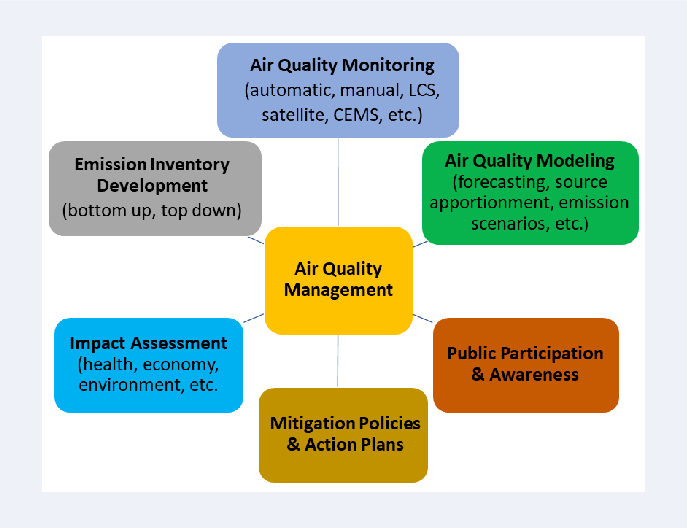
Rapid urbanization and industrialization in tropical regions have intensified challenges related to deteriorating air quality, climate resilience, and public health. This talk will focus on glimpses of contemporary research initiatives addressing these multidimensional issues through both fundamental investigations and applied innovations. Our studies span from nature-based strategies for mitigating the Urban Heat Island effect and ambient air pollution to the quantification of atmospheric black carbon emissions from open biomass burning and their spatio-temporal variability over southern India. We further examine the complex dynamics of secondary aerosol formation and its implications for human exposure. These findings underscore the evolving nature of airborne pollutants and their intersection with urban lifestyles. Complementing these field-based assessments, our experimental work on composite photocatalysts provides an advanced materials perspective for indoor air purification and pollutant degradation under ambient conditions. Together, these investigations present a holistic framework for air quality management—linking source characterization, exposure assessment, and sustainable mitigation technologies. The talk highlights the necessity of integrating traditional environmental monitoring with emerging analytical tools and nature-inspired engineering solutions to achieve cleaner air and healthier cities.