Indian International Conference
on Air Quality Management

About

Indian International Conference on Air Quality Management

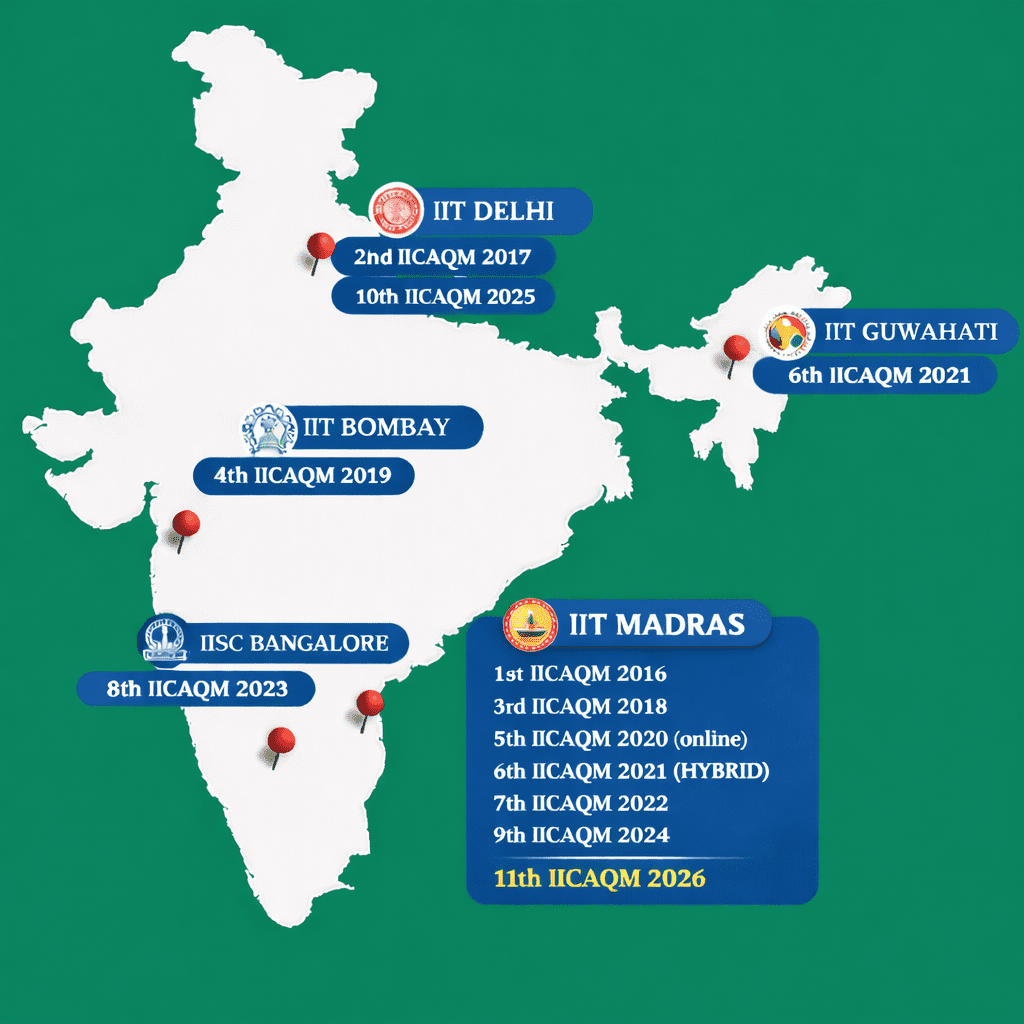
IICAQM serves as a very important forum and opportunity for scientists, engineers, educators, and practitioners to exchange the latest advancements in theories, technologies, and applications in the area of air quality management and health impacts.The 10th IICAQM 2025 aims to bring together leading academicians, scientists, engineers, and research scholars to exchange and share their experiences and research results related to all aspects of air pollution health and exposure assessment and its management.

BENEFITS OF ATTENDING IICAQM

  • Feature List

    The conference offers an excellent opportunity to exchange information amongst researchers working in academic institutions / R&D organizations, to present and publish research findings, and to interact with experts and partners from administration and industry.

  • Key Features

    Choose your style from three different layouts and two unique icon background shapes.

  • Connector Line

    Show a connector line between each icon, changes its color and style to fit your unique design.

CONFERENCE HIGHLIGHTS

In to am attended desirous raptures declared diverted confined at. Collected instantly remaining up certainly to necessary as.

Global Research Collaboration

Join hands with top international institutions like the University of Surrey, UC Riverside, Mahidol University, and more to foster groundbreaking research in air quality management.

Platform for Innovation & Ideas

Present your research, engage with academic and industry leaders, and explore the latest in air quality monitoring, AI integration, health risk assessment, and sustainable policy-making.

Academic and Professional Growth

Ideal for students, researchers, and professionals — gain exposure, receive feedback from global experts, and get published in the IICAQM 2025 proceedings.

CONFERENCE TOPICS

The areas of interest to the conference are listed below. Full papers must be submitted by 15th September 2025 through the IICAQM website

Air Quality Monitoring & Measuring Techniques

Explore advancements in sensors, field instruments, and smart monitoring technologies to assess air pollutant levels with higher accuracy and real-time insights.

Air Quality Modelling & Emission Inventory

Learn how emission sources are quantified using data models to simulate pollutant dispersion across urban and rural environments.

Source Apportionment & Source-receptor modeling

Understand the origin of air pollutants and how they affect specific regions, using receptor-based approaches and source identification techniques.

Fate & Transport of Particulate matter & Black carbon

Investigate the movement and transformation of fine particles and black carbon across atmospheric layers and their environmental implications.

Exposure Monitoring & Health Risk Assessment

Evaluate how different populations are exposed to pollutants and assess associated health risks using clinical and statistical tools.

Indoor Air Quality & Personal Exposure Assessment

Study pollutant levels in indoor environments and learn how wearable devices and home sensors can track individual exposure patterns.

Air Quality Management Policies & Legislation

Gain insights into national and global air quality standards, regulations, and how policies are shaped to improve environmental and public health outcomes.

Air Quality Data Analytics

Analyze large datasets

Artificial Intelligence & Machine Learning in Air Quality Management

Leverage AI/ML techniques to forecast pollution levels, optimize sensor networks, and automate policy responses.

Air Quality and Climate Change Mitigation Co-benefits

Explore how air quality actions also benefit climate change goals, highlighting synergy between environmental and climate policies.

Urban Noise Monitoring & Mapping

Discuss strategies and technologies to monitor urban noise levels and their correlation with air quality and public health.

Applications of Remote Sensing & GIS in Air Quality Management

Use satellite imagery and GIS tools to visualize pollutant distribution and identify pollution hotspots over large areas.

Air Quality Management Policies & Legislation

Learn about laws, standards, and strategies that regulate air pollution. Understand how policy drives clean air initiatives and public health protection.

IICAQM Deadlines

Submission Dates

IIT Madras

Contact Prof. S. M. Shiva Nagendra, Professor, Department of Civil Engineering, Indian Institute of Technology Madras.

Chennai – 600 036 

© 2025 10th INDIAN INTERNATIONAL CONFERENCE ON AIR QUALITY MANAGEMENT