
IIT Delhi

Dr. Ravi Kumar Kunchala earned his Master’s degree in Meteorology from Andhra University in 2008, followed by a Ph.D. from the Indian
Institute of Tropical Meteorology (IITM), Pune, in 2014. After completing his doctoral studies, he joined the Japan Agency for Marine-Earth
Science and Technology (JAMSTEC), where he contributed to a major Arctic climate change project focused on understanding greenhouse gas
variations over Siberia. He subsequently expanded his research career through involvement in the Indo-German STRATOCLIM project and later
served as a Postdoctoral Researcher at King Abdullah University of Science and Technology (KAUST), Saudi Arabia, further strengthening his
expertise in atmospheric composition research through observations and modeling methodologies.
Dr. Kunchala is currently an Associate Professor at the Centre for Atmospheric Sciences, Indian Institute of Technology Delhi (IIT Delhi). His
ongoing research focuses on developing a comprehensive understanding of greenhouse and trace gases over India through an integrated approach
that combines multi-platform observations and advanced modeling techniques. His work also addresses a wide range of topics related to
atmospheric composition, including air pollution, and regional climate interactions, using high-resolution modeling frameworks. To date, Dr.
Kunchala has authored and co-authored around 60 peer-reviewed publications in leading international and national journals, contributing
significantly to advancements in atmospheric composition and climate research.
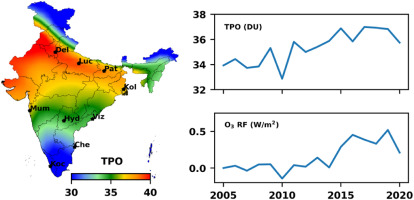
In recent decades, there has been a notable rise in scientific attention toward tropospheric ozone (O₃) due to its vital role in regulating the oxidative capacity of the atmosphere, its influence on air quality, and its adverse impacts. Over India, tropospheric ozone exhibits marked spatial and temporal variability, influenced by a complex interplay of anthropogenic emissions, biogenic sources, and meteorological factors. Understanding the spatiotemporal variability of surface ozone across India is particularly important, as it is one of the most harmful air pollutants, and comprehensive scientific assessments on these aspects remain limited. Although several studies have investigated surface ozone at specific sites, a thorough evaluation of the vertical and horizontal distribution of tropospheric ozone over India is still lacking. This presentation focuses on investigating the spatiotemporal variability of tropospheric ozone over the Indian subcontinent through the integration of ground-based and satellite observations along with reanalysis datasets. This approach aims to provide improved insights into the underlying trends and drivers of ozone variability, thereby enhancing our understanding of its implications for regional air quality and climate interactions. We also present an analysis on the tropospheric ozone variations associated with Rossby Wave Breaking events from a climatological perspective.
© 2026 11th INDIAN INTERNATIONAL CONFERENCE ON AIR QUALITY MANAGEMENT
